Friday, June 9, 2023


 Introduction:

    Cloud computing has emerged as a transformative force, revolutionizing the way individuals, businesses, and organizations access, store, and manage data and applications. This groundbreaking technology has opened up new possibilities and paved the way for unprecedented scalability, flexibility, and efficiency in the digital realm. In this article, we will delve into the world of cloud computing, exploring its key concepts, benefits, and its impact on various sectors.


Cloud Computing

I. Understanding Cloud Computing:

    At its core, cloud computing refers to the delivery of computing services—such as servers, storage, databases, software, and networking—over the internet. Instead of relying solely on local infrastructure, users can access these resources remotely, on-demand, and pay only for what they use. Several key components define the essence of cloud computing:


Infrastructure as a Service (IaaS): 

    IaaS provides virtualized computing resources, including servers, storage, and networks. Users can manage and control these resources while leaving the underlying infrastructure maintenance to the cloud service provider.


Platform as a Service (PaaS): 

    PaaS offers a complete development and deployment environment, empowering developers to create, test, and deploy applications without worrying about the underlying infrastructure.


Software as a Service (SaaS): 

    SaaS delivers software applications over the internet on a subscription basis. Users can access these applications from any device with an internet connection, without the need for local installation or maintenance.


II. Benefits of Cloud Computing:

    Cloud computing offers a plethora of benefits that have revolutionized the digital landscape. Let's explore some of its key advantages:


Scalability and Flexibility: 

    Cloud computing allows users to scale resources up or down based on demand. This scalability enables businesses to handle fluctuating workloads efficiently, avoiding overprovisioning or underutilization of resources.


Cost-Efficiency: 

    Cloud computing follows a pay-as-you-go model, eliminating the need for significant upfront infrastructure investments. Users can optimize costs by paying only for the resources they consume, reducing capital expenditure and maintenance costs.


Accessibility and Mobility: 

    With cloud computing, data and applications are accessible from anywhere with an internet connection. This accessibility promotes remote work, collaboration, and enhances productivity by enabling users to work across various devices seamlessly.


Reliability and Disaster Recovery: 

    Cloud service providers typically offer robust infrastructure, redundant systems, and data backup capabilities. This ensures high availability, data redundancy, and reliable disaster recovery options, minimizing the risk of data loss or service interruptions.


Innovation and Time-to-Market: 

    Cloud computing provides developers with readily available resources and platforms, accelerating the development and deployment of applications. This agility fosters innovation and reduces time-to-market for new products and services.


III. Impact on Various Sectors:

    Cloud computing has had a transformative impact on numerous industries, driving innovation and efficiency across sectors:


Business and Enterprise: 

    Cloud computing enables businesses to streamline operations, enhance collaboration, and improve customer experiences. It facilitates real-time data analysis, empowers remote work, and supports scalable solutions for businesses of all sizes.


Education: 

    Cloud-based platforms have revolutionized the education sector by facilitating online learning, collaboration, and access to educational resources from anywhere. It enables virtual classrooms, personalized learning experiences, and easy data management for educational institutions.


Healthcare: 

    Cloud computing enhances patient care, data management, and medical research. It enables secure storage and sharing of electronic health records, remote patient monitoring, and analysis of vast amounts of healthcare data to facilitate improved diagnosis and treatment.


Government: 

    Cloud computing offers government agencies cost-effective solutions, streamlined operations, and improved citizen services. It enables efficient data sharing, secure storage of sensitive information,

Saturday, March 21, 2020

Cloud Computing Services


Cloud Computing Services

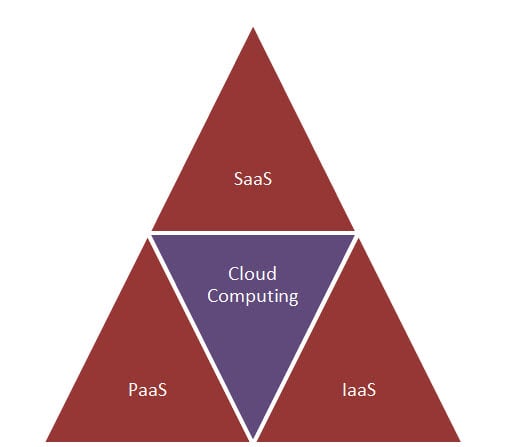
The three major Cloud Computing Offerings are
  • Software as a Service (SaaS)
  • Platform as a Service (PaaS)
  • Infrastructure as a Service (IaaS)
Different business use some or all of these components according to their requirement.
Cloud Computing for Beginners

SaaS (Software as a Service)

SaaS or software as a service is a software distribution model in which applications are hosted by a vendor or service provider and made available to customers over a network (internet). SaaS is becoming an increasingly prevalent delivery model as underlying technologies that supports Service Oriented Architecture (SOA) or Web Services. Through internet this service is available to users anywhere in the world. 
Cloud Computing for Beginners
Traditionaly, software application needed to be purchased upfront &then installed it onto your computer. SaaS users on the other hand, instead of purchasing the software subscribes to it, usually on monthly basisvia internet.
Anyone who needs an access to a particular piece of software can be subscribe as a user, whether it is one or two people or every thousands of employees in a corporation. SaaS is compatible with all internet enabled devices.
Many important tasks like accounting, sales, invoicing and planning all can be performed using SaaS.

PaaS (Platform as a Service)

Platform as a service, is referred as PaaS, it provides a platform and environment to allow developers to build applications and services. This service is hosted in the cloud and accessed by the users via internet.
To understand in a simple terms, let compare this with painting a picture, where you are provided with paint colors, different paint brushes and paper by your school teacher and you just have to draw a beautiful picture using those tools. 
Cloud Computing for Beginners
PaaS services are constantly updated & new features added. Software developers, web developers and business can benefit from PaaS. It provides platform to support application development. It includes software support and management services, storage, networking, deploying, testing, collaborating, hosting and maintaining applications.

IaaS (Infrastructure as a Service)

IaaS (Infrastructure As A Service) is one of the fundamental service model of cloud computing alongside PaaS( Platform as a Service). It provides access to computing resources in a virtualized environment “the cloud” on internet.  It provides computing infrastructure like virtual server space, network connections, bandwidth, load balancers and IP addresses. The pool of hardware resource is extracted from multiple servers and networks usually distributed across numerous data centers.  This provides redundancy and reliability to IaaS.
Cloud Computing for Beginners
IaaS(Infrastructure as a service) is a complete package for computing. For small scale businesses who are looking for cutting cost on IT infrastructure, IaaS is one of the solutions. Annually a lot of money is spent in maintenance and buying new components like hard-drives, network connections, external storage device etc. which a business owner could have saved for other expenses by using IaaS.

source : https://www.guru99.com/cloud-computing-for-beginners.html

cloud computing and the benefits.


Why the Name Cloud?

The term “Cloud” came from a network design that was used by network engineers to represent the location of various network devices and there inter-connection.  The shape of this network design was like a cloud.
 Cloud Computing for Beginners

Why Cloud Computing?

With increase in computer and Mobile user’s, data storage has become a priority in all fields. Large and small scale businesses today thrive on their data & they spent a huge amount of money to maintain this data. It requires a strong IT support and a storage hub. Not all businesses can afford high cost of in-house IT infrastructure and back up support services. For them Cloud Computing is a cheaper solution. Perhaps its efficiency in storing data, computation and less maintenance cost has succeeded to attract even bigger businesses as well.
Cloud computing decreases the hardware and software demand from the user’s side. The only thing that user must be able to run is the cloud computing systems interface software, which can be as simple as Web browser, and the Cloud network takes care of the rest. We all have experienced cloud computing at some instant of time, some of the popular cloud services we have used or we are still using are mail services like gmail, hotmail or yahoo etc.
While accessing e-mail service our data is stored on cloud server and not on our computer. The technology and infrastructure behind the cloud is invisible. It is less important whether cloud services are based on HTTP, XML, Ruby, PHP or other specific technologies as far as it is user friendly and functional. An individual user can connect to cloud system from his/her own devices like desktop, laptop or mobile.
Cloud computing harnesses small business effectively having limited resources, it gives small businesses access to the technologies that previously were out of their reach.  Cloud computing helps small businesses to convert their maintenance cost into profit. Let’s see how?
In an in-house IT server, you have to pay a lot of attention and ensure that there are no flaws into the system so that it runs smoothly. And in case of any technical glitch you are completely responsible; it will seek a lot of attention, time and money for repair. Whereas, in cloud computing, the service provider takes the complete responsibility of the complication and the technical faults.

Benefits of Cloud Computing

The potential for cost saving is the major reason of cloud services adoption by many organizations.  Cloud computing gives the freedom to use services as per the requirement and pay only for what you use. Due to cloud computing it has become possible to run IT operations as a outsourced unit without much in-house resources.
Following are the benefits of cloud computing:
  1. Lower IT infrastructure and computer costs for users
  2. Improved performance
  3. Fewer Maintenance issues
  4. Instant software updates
  5. Improved compatibility between Operating systems
  6. Backup and recovery
  7. Performance and Scalability
  8. Increased storage capacity
  9. Increase data safety

Thursday, May 2, 2019

Cloud Computing(1)


Cloud computing is a general term for anything that involves delivering hosted services over the Internet. These services are broadly divided into three categories:

Infrastructure-as-a-Service (IaaS),

Platform-as-a-Service (PaaS)

Software-as-a-Service (SaaS).

The name cloud computing was inspired by the cloud symbol that's often used to represent the Internet in flowcharts and diagrams.
A cloud service has three distinct characteristics that differentiate it from traditional web hosting.
It is sold on demand, typically by the minute or the hour,
 It is elastic -- a user can have as much or as little of a service as they want at any given time; and the service is fully managed by the provider (the consumer needs nothing but a personal computer and Internet access). Significant innovations in virtualization and distributed computing, as well as improved access to high-speed Internet, have accelerated interest in cloud computing.
A cloud can be private or public. A public cloud sells services to anyone on the Internet. (Currently, Amazon Web Services is the largest public cloud provider.) A private cloud is a proprietary network or a data center that supplies hosted services to a limited number of people. Private or public, the goal of cloud computing is to provide easy, scalable access to computing resources and IT services.

Cloud computing deployment models :

Private cloud services are delivered from a business's data center to internal users. This model offers the versatility and convenience of the cloud, while preserving the management, control and security common to local data centers. Internal users may or may not be billed for services through IT chargeback. Common private cloud technologies and vendors include VMware and OpenStack.
In the public cloud model, a third-party cloud service provider delivers the cloud service over the internet. Public cloud services are sold on demand, typically by the minute or hour, though long-term commitments are available for many services. Customers only pay for the CPU cycles, storage or bandwidth they consume. Leading public cloud service providers include Amazon Web Services (AWS), Microsoft Azure, IBM and Google Cloud Platform.
A hybrid cloud is a combination of public cloud services and an on-premises private cloud, with orchestration and automation between the two. Companies can run mission-critical workloads or sensitive applications on the private cloud and use the public cloud to handle workload bursts or spikes in demand.The goal of a hybrid cloud is to create a unified, automated, scalable environment that takes advantage of all that a public cloud infrastructure can provide, while still maintaining control over mission-critical data.

Cloud Computing


Cloud computing

Cloud computing is a big shift from the traditional way businesses think about IT resources. Here are six common reasons organisations are turning to cloud computing services:


Cost

Cloud computing eliminates the capital expense of buying hardware and software and setting up and running on-site datacenters—the racks of servers, the round-the-clock electricity for power and cooling, the IT experts for managing the infrastructure. It adds up fast.


Speed

Most cloud computing services are provided self service and on demand, so even vast amounts of computing resources can be provisioned in minutes, typically with just a few mouse clicks, giving businesses a lot of flexibility and taking the pressure off capacity planning.


Global scale

The benefits of cloud computing services include the ability to scale elastically. In cloud speak, that means delivering the right amount of IT resources—for example, more or less computing power, storage, bandwidth—right when it is needed and from the right geographic location.


Productivity

On-site datacenters typically require a lot of “racking and stacking”—hardware set up, software patching and other time-consuming IT management chores. Cloud computing removes the need for many of these tasks, so IT teams can spend time on achieving more important business goals.


Performance

The biggest cloud computing services run on a worldwide network of secure datacenters, which are regularly upgraded to the latest generation of fast and efficient computing hardware. This offers several benefits over a single corporate datacenter, including reduced network latency for applications and greater economies of scale.


Security

Many cloud providers offer a broad set of policies, technologies and controls that strengthen your security posture overall, helping protect your data, apps and infrastructure from potential threats.


 Introduction:      Cloud computing has emerged as a transformative force, revolutionizing the way individuals, businesses, and organizati...